Amitabh Bachchan's on-air reaction: KBC 18 host responds to Kasab claim
· Times of India
· Times of India
· Free Press Journal
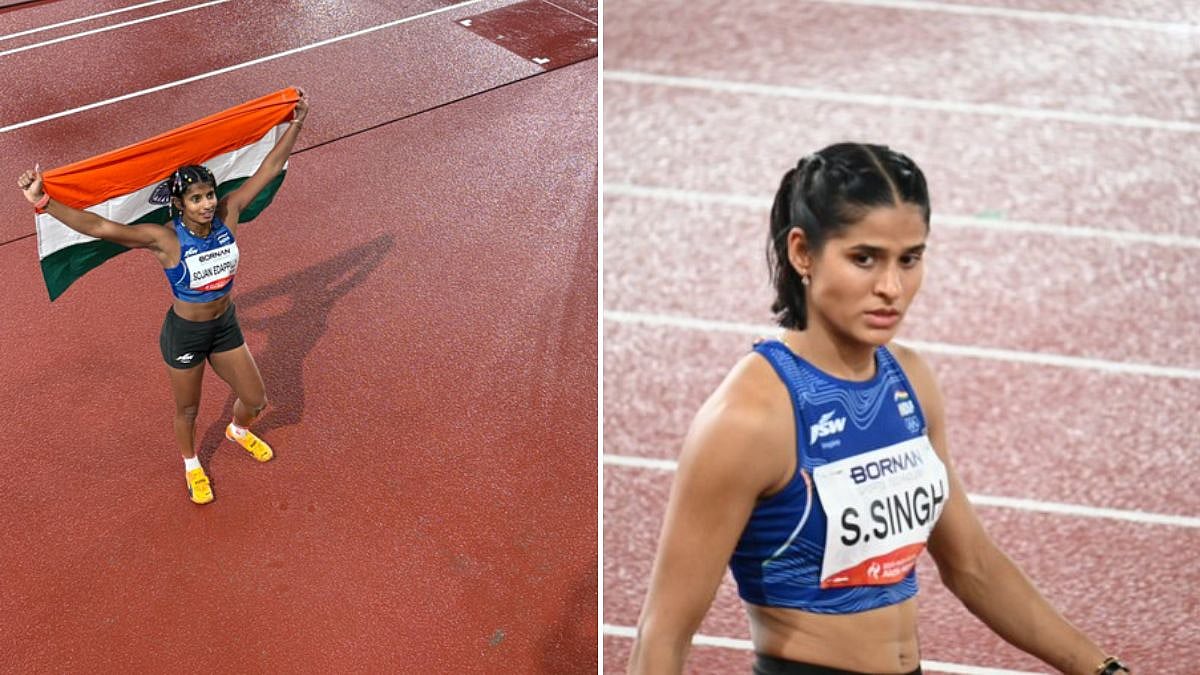
Nagoya, Sep 27: India’s Ancy Sojan won the women’s long jump silver medal at the Asian Games Aichi-Nagoya 2026 on Sunday after China’s Huang Yingying produced a 6.55m effort with her final jump to edge the Indian by two centimetres in a dramatic finish at the Nagoya City Mizuho Park Athletic Stadium. Shaili Singh, who had remained in medal contention for much of the competition, finished fourth.
Visit rouesnews.click for more information.
Ancy had put herself in the gold-medal position right from her opening attempt, clearing 6.49m. Her second jump was ruled a foul, but the opening effort was enough to keep her at the top as the competition progressed.
Shaili began with 6.25m before improving to 6.34m in her second attempt. She repeated that distance with her third jump and remained within striking distance of the medals as the field narrowed to the top eight after three rounds.
The battle at the top became increasingly tight in the fourth round. Shaili registered 6.41m after requesting that her jump be checked, moving into third place. Ancy, meanwhile, could only manage 6.31m with her fourth attempt but retained the lead with her earlier 6.49m.
The fifth round transformed the contest again. Huang matched Ancy’s 6.49m, putting the two level at the top. Ancy responded immediately, producing a 6.53m jump to reclaim the lead and move within one attempt of gold.
Tamil Nadu CM Vijay Announces ₹50 Lakh Reward For Squash Player Abhay Singh After Asian Games Silver Medal TriumphBut the Chinese athlete had the final say.
Huang saved her best for the last attempt, jumping 6.55m to move two centimetres ahead of Ancy. The Indian’s final effort measured 6.49m, leaving her with silver despite having occupied the gold-medal position for much of the competition.
Shaili was also denied a podium finish in the closing stages. Having moved into third with her 6.41m fourth-round effort and improved to 6.42m in the fifth, she was overtaken by China’s Mengyi Tan, who produced a 6.46m final jump. Shaili therefore ended the competition fourth with 6.42m.
The result gave India silver in an event in which the country had previously won only one women’s long jump gold at the Asian Games, through Anju Bobby George in 2002.
For Ancy, the medal adds another major result to a breakthrough 2026 season in which she produced a national record of 6.88m at the World Athletics Continental Tour event in Bhubaneswar.
(Except for the headline, this article has not been edited by FPJ's editorial team and auto-generated from an agency feed.)
· Scroll
Visit esporist.org for more information.
Calisthenics has gained enormous popularity in recent years, particularly thanks to social media and the rise of workout areas in city parks. You probably know some of the moves already, like pull-ups, push-ups, dips and squats.
For the more advanced, it also includes eye-catching, gravity-defying moves like the muscle-up, planche (where the body is held horizontal, supported solely by the hands) or the front lever (where the body is held horizontally while hanging from a bar).
But is calisthenics an effective form of exercise, or just another fitness fad? To answer this question, we first need to clarify what it is.
Calisthenics is a form of training that mainly uses a person’s own body weight as resistance. Its name derives from the Greek terms kállos (“beautiful”) and sthenos (“strength”), though the word’s modern use only caught on during the 19th century, when it referred to various forms of physical exercise.
Today, it includes well-known exercises such as squats, lunges, push-ups, pull-ups and dips, but calisthenics is not inherently acrobatic. Anyone who starts by doing a simple wall push-up is using the same principle as someone doing a one-arm push-up on the ground: moving their body against gravity.
Our body weight is a considerable load. During a conventional push-up, for example, the arms can support around two-thirds of...